

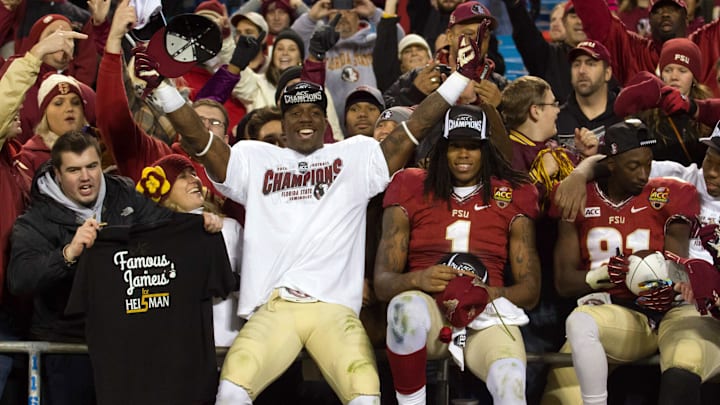
The disrespect of the 2013 Florida State football team has to stop. Recently, a debate about which team would win between the 2001 Miami Hurricanes and the 2013 Florida State team popped up on social media. Both teams were undefeated, but FSU was clearly the better team.
That team has the best offense in college football history, averaging 51.6 points per game, and a defense that led college football by allowing only 12.1 points per game. They did both feats with their backup players playing significant snaps in the second half of nearly every game. FSU set an FBS record, winning by an average margin of 39.5 points per game.
Nevertheless, a Miami writer gave his reasons why Miami was the superior program, but the claims hold zero weight:
- The 2001 Miami Hurricanes carried a level of roster depth that extended far beyond their starting lineup. They produced more than 40 NFL players, including 15 first-round draft picks, and several future All-Pros who were backups on the Miami roster during the season.
- Some critics of the all-time status of the 2001 Miami focus strictly on the strength of schedule. Even accounting for that context, statistical evidence from the period suggests Miami played against teams with stronger overall records than Florida State did in its 2013 title run.
- If you anchor this matchup in tangible factors observable across eras — roster depth, dominance of performance, production of professional talent, and consistent control of games — the argument favours the Hurricanes.
The first bullet makes zero sense. Why would you factor guys who went on to play in the NFL if they were not playing major roles THAT season? Who cares what they did in the NFL? The argument is how those two teams would match up at THAT time, not after they went to the NFL. FSU had a MAJOR edge at quarterback, and Devonta Freeman’s season at running back was better than Clinton Portis's. Karlos Williams and James Wilder Jr. were better than Frank Gore and Willis McGahee that season. Nick O’Leary matches Jeremy Shockey at tight end. FSU had a better passing attack than Miami. FSU’s defense played two more games with backups playing nearly the entire second half in every game, and still only allowed 12 ppg. Did I mention kicker Roberto Aguayo outscored teams by himself that year?
Miami was playing in the Big East, where they faced TWO ranked teams all season. They played five ranked teams total, and the highest-ranked team they beat was No. 4 Nebraska in the title game. Florida State also beat five ranked teams, including three top 10 teams. The margin of victory against those three top 10 teams was 22.3 points.
That third bullet is the ultimate word salad. I destroyed the roster depth point attempt and proved FSU was more dominant. What players went on to do in the NFL doesn’t mean anything, and FSU had backups playing in the second halves of every game. If the starters played the entire game, they would have set offensive records that wouldn’t have been touched in the College Football Playoff era with 2-3 extra games!
Put it this way. If 2013 FSU played Miami’s 2001 schedule? They would have been more dominant than the 2001 Miami team against Florida State’s 2013 schedule, and 2013 FSU beats 2001 Miami because they were a more complete team in all three phases.
 Add us as a preferred source on Google