

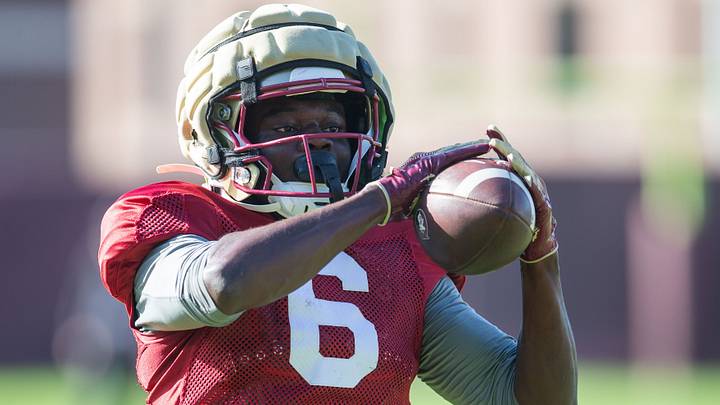
On Thursday, Day 2 of Florida State fall camp, deputy head coach Chris Thomsen, who also coaches the tight ends in Tallahassee, raved about one of Florida State’s most underrated transfer portal pickups: tight end Desirrio Riles.
“He has the ability to run some routes out in space that some tight ends don’t have. He’s got some really good top-end speed that will get him down the seams and get him on the crosses,” Thomsen said when breaking down the game of this offseason’s splashiest addition to his position room in a press conference video courtesy of Noles 247.
The 6-foot-3, 235-pound senior originally from Jacksonville transferred in from East Carolina off a 28-catch, 362-yard season last year. That’s relatively modest production and still far and away the best of his career.
Yet, Riles, who at one time was a QB and DE at Florida State prospect camps, has already clearly established himself as TE1 for Norvell. His position coach sees his skillset as unique, and with the Seminoles pushing to run more 12 (1 running back, 2 tight ends) and 13 personnel (1 RB, 3 TEs) this season, he’ll be an every-down player this fall.
So, I dove into his film to see what has Thomsen and the FSU staff buzzing about Riles and how his game can potentially unlock Norvell’s offense.
Desirrio Riles scouting report
Profile:
- Eligibility left: 2 years (SR)
- Height: 6’3”
- Weight: 235 lbs
- Previous school: East Carolina
- 2025 production: 28 rec, 362 yards, 12.9 yards/rec, 2 TD
Strengths:
Field-stretching speed - You think of a field-stretcher as a blazer on the outside, Micahi Danzy, or a jump-ball machine, Duce Robinson. Riles isn’t either. He’s compactly built with short arms and a relatively small catch radius for a tight end. Yet, he can legitimately threaten a defense downfield because of his speed on seams and benders.
Feel for leverage - Riles doesn’t win those seams, benders, and crossers simply because he’s fast for a tight end. He also has a clear understanding of leverage and how to present himself as a quarterback-friendly target over the middle. He can feel safeties over the top and see lanes behind linebackers to optimize his routes and maximize the space his QB has to throw into.
Quick in-and-out of routes - It’s not all seams and benders for Riles. With his compact build, he has a lower center of gravity than most tight ends, so just as his acceleration is a strength, his ability to decelerate into breaks also allows him to create separation. Riles can run a legitimate route tree.
Weaknesses:
Blocking - Riles’s modest production came partially because he stayed in as a pass blocker on over a quarter of the passing plays he was on the field for at ECU last season. In that capacity, picking up linebackers blitzing from depth or helping to chip on the outside, Riles is a quality blocker. His stout frame allows him to absorb contact well and anchor to avoid getting run through.
The weakness of that frame, however, shows up in space. His apparent lack of length causes issues when blocking in space, either in the run game or on screens and swings. There are plenty of open-field whiffs on his tape.
Concentration drops - While Riles has the body to take a beating over the middle, at times he can get a bit overanxious, wanting to dish out some punishment himself. He had three drops on 41 targets last year. That’s far from alarming, as he’s coordinated and natural as a pass-catcher, but it’s worth noting.
Desirrio Riles can unlock FSU’s 12-personnel but his blocking has to improve to justify it
When Mike Norvell called plays for Florida State before ceding the responsibility to Gus Malzahn in 2025, the Seminoles utilized 12 personnel at one of the higher rates in the country. Norvell tends to favor 12 and 21 personnel (2 RBs, 1 TE) as part of his offensive philosophy, and all indications are that he’ll return to that in 2026.
Riles, with his ability to threaten the defense vertically over the middle and versatility as a move tight end, with 47.8 percent of his snaps last season coming from the slot and 32 percent as an in-line tight end, he could unlock two-tight end looks for FSU.
Across the NFL and college football, tight end usage is up. 13 personnel rates peaked in the NFL last season, and in college, College Football Playoff teams like Ohio State and Oregon consistently ran two-tight-end sets. Heavy personnel groupings force the defense to put bigger bodies on the field, and if your tight ends are athletes, that can set up the explosive pass game.
Riles can be that player for Florida State, so long as his presence on the field sufficiently frightens opponents into putting an extra linebacker onto the field rather than staying in nickel or dime. He and TE Landon Thomas have to do that by proving their mettle as run-blockers.
That’s not to say you have to run to set up the pass. That’s never proven to be statistically true in the history of football. But Norvell’s goal with heavy personnel is to influence the defense, either to add a linebacker or bring a safety down toward the line of scrimmage, and that doesn’t happen if Riles is treated as an oversized slot receiver.
Thomsen called Riles and Thomas his two best blockers on Thursday. From the film I watched on Riles, that’s more alarming than it is comforting. Especially because many of his limitations appear to be physical. But if improvements have been made and he’s not simply one of the best blockers by default, FSU may have uncovered a difference-making weapon who can unlock a power-spread offense.
 Add us as a preferred source on Google