

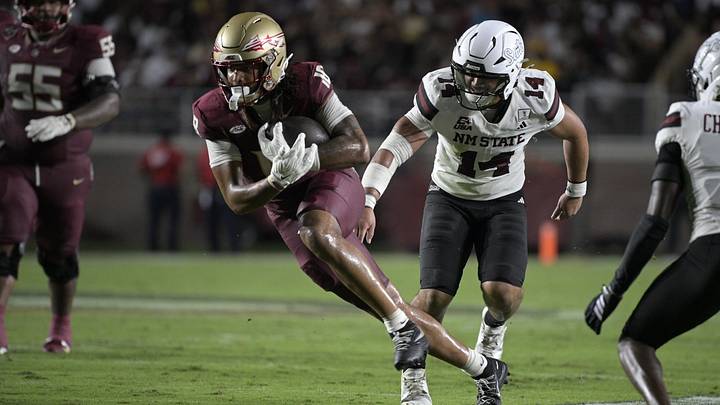
Sometimes, when coaches say things in press conferences, they’re trying to convince the outside world it’s the truth. Other times, they’re trying to convince themselves and their team. The latter was almost definitely the case this week when head coach Mike Norvell said of his tight ends’ blocking efforts in Florida State’s 34-17 win over New Mexico State: “I thought they did a really good job.”
Relative to expectations, that might actually be true. Desirrio Riles, Landen Thomas, and Chase Loftin were all adequate blockers against New Mexico State, particularly throwing kick-out blocks on the backside in the second half when Norvell began to spam split-zone duo. However, none are impact blockers, particularly against Power Conference competition, and that’s a significant problem when you consider the construction of this roster.
Florida State’s TEs limit Mike Norvell’s ability to problem-solve as a play-caller
Loftin had seven run-blocking reps in Week 0, but Riles and Thomas were the primary options at tight end for Florida State. Riles has a compact build at 6-foot-3, 235 pounds, and doesn’t have great length, so while he can deliver a decent blow on a wham block, he’s easy for longer defensive players to stack and shed in the run game and will often lose the hand fight when pass-blocking.
Thomas has the opposite problem. Though his measurements are similar at 6-foot-4, 235 pounds, he’s much longer with a higher center of gravity, so he’ll attempt to protect himself on wham or kick-out blocks, leading with his shoulder, which makes him easy to evade. His length allows him to stay attached as a pass-blocker, but he’s too upright and loses leverage quickly.
Many college tight ends are glorified receivers, so in some ways, the fact that Riles and Thomas provide anything as blockers is a positive. However, they’re both more H-back types, and their limitations as true in-line tight ends severely limit Norvell’s ability to solve problems on his offense.
The primary problem that needs solving is at right tackle. Stephen F. Austin transfer Chimdia Nwaiwu got chewed up in his Florida State debut. That could force Norvell and offensive line coach Herb Hand to move right guard Nate Pabst out to tackle and insert Troy transfer Paul Bowling at right guard, but Pabst would likely still need help on true pass sets.
See this issue? Whoever starts at right tackle, Riles and Thomas don’t offer much help. They, like many college tight ends, are primarily pass-catching weapons, but Florida State’s biggest strength on offense is all of its weapons, both at wide receiver and tight end. So every time an extra tight end is on the field, Samuel Singleton Jr., Jayvan Boggs, Jasen Lopez, or another top skill player is off it.
Norvell and John Garrett should have prioritized a blocking TE for this offense
Really, this all stems from the deficiency at right tackle. But Norvell and general manager John Garrett had to know that was a possibility, which makes adding Riles rather than a more traditional tight end in the portal this offseason a bit confounding.
There’s a world in which a heavy-personnel version of this FSU offense forces defenses to stack the box and allows Ashton Daniels to take shots to Duce Robinson and Micahi Danzy. Where Norvell can toggle between heavy sets and spread looks depending on the matchup, either protecting his right tackle with quick-game or with max protection. But after what Riles and Thomas showed as blockers in Week 0, that world likely doesn’t exist.
Some version of that could be accomplished with 21-personnel, leaning on two-running back sets to create conflict in the defense, but over the course of a season, without a reliable blocking tight end, even that may become predictable.
 Add us as a preferred source on Google