

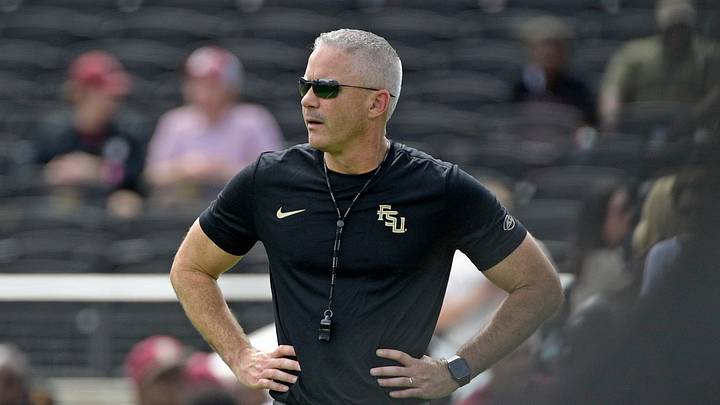
With half of the college football season officially complete, Florida State is staring down a difficult second half that could truly dictate where the team finishes the year. As things currently stand, the Seminoles are projected to finish the season with a 6-6 record, closing out the year with wins over Clemson, Boston College, and NC State.
Given some of the chaos that has gone on this season, a 6-6 record would be a slight improvement over where the team finished in 2025. However, 6-6 would still be far below where this team needs to finish in order to push for conference titles and playoff berths.
The Seminoles have been one of the better teams in the ACC in some areas, but in others, the team sinks straight to the bottom of the conference.
Stat #1: Opponent points per game - 27.9
Florida State has had some positive moments on defense this season, particularly against Virginia, but a major issue the defense faces moving forward involves limiting opponents' scoring chances across a full four quarters. Opponents are currently averaging 27.9 points per game against the Seminoles' defense, and to put it bluntly, that will not get the job done.
Florida State has allowed 59 points to be scored after the second quarter in the two losses to Louisville and Miami. This trend can also be seen in the losses to SMU and Alabama, with 34 points being scored in the second half. Opposing teams tend to come out stronger from the break against the Seminoles, while the defense struggles to maintain the same success from the first portion of each game.
27.9 points per game allowed is not a good statistic whatsoever, but the fact that opposing teams are doing an incredible amount of damage in the second half of games makes the situation worse. The Seminoles are often putting themselves in a winning position early on in games before the defense ultimately crumbles, which has been increasingly frustrating to watch each week.
Stat #2: Passing yards allowed per game - 256.3
While the offense has struggled at times, Florida State's biggest weakness this season has been on defense. The rush defense is not particularly pretty, allowing 178.6 yards per game, but the real issue for the Seminoles has been the secondary.
Between miscommunications, blown coverages, and injuries, Florida State is allowing opponents to record 256.3 passing yards per game. The statistic alone may not look that bad, but it gets worse the more you look into it. Florida State allows opponents to gain 8.2 yards per completion (last in the ACC), and opponents are completing their passes 62.7% of the time.
Opposing quarterbacks have thrived through the air against Florida State, and when combined with the success on the ground, the Seminoles are off-balance defensively from the start of each game.
The issue for Florida State is that the problem does not necessarily have a quick fix. The run defense was atrocious early in the season, but there have been some improvements that have been made as players like Mandrell Desir shifted along the defensive line. Florida State cannot afford to move everyone in the secondary around, and with a limited number of healthy bodies to begin with, there really aren't many moves to be made.
Stat #3: Total rushing yards - 1261
Florida State's offense has not been perfect this season, but there are a few areas where the team has excelled, leading to some positive results on the field. The success of Florida State this season starts and ends with the run game, which has been a three-headed attack of sorts. Quarterback Ashton Daniels is a very comfortable runner, and his willingness to risk his body and escape defenders has taken some pressure off of a bad offensive line.
It has not been all Daniels, however, with Ousmane Kromah carrying the team at times this season on offense. Kromah has not necessarily been the man scoring all the touchdowns or breaking off massive gains, but his consistency and 5.3 yards per rush help push the offense forward. Florida State could have a difficult time trying to replicate what Kromah does on the ground, but Tre Wisner appears up to the task, with a similar 5.4 yards per rush with only 38 carries.
Wisner is a successful running back, and freshman Amari Thomas is likely going to be stepping into a prominent role moving forward. However, the key to Florida State tacking on consistent yardage on the ground without Kromah will be Daniels. His ability to generate big gains with ease will come in handy for the Seminoles down the stretch.
Stat #4: Average yards per reception - 15
The passing game has been inconsistent for Florida State this season, with Daniels failing to cross the 300-yard mark once this season against Alabama. It has not been the most powerful passing attack, but when Daniels is able to connect with his receivers, good things tend to happen.
Florida State currently averages 15 yards per reception this season, as Duce Robinson and Jayvan Boggs both snatch 18.5 yards per reception. Robinson and Boggs have both been big-play candidates all season when the ball is in their hands, and Micahi Danzy has also been able to create a similar impact with his receptions.
Without starting running backs Ousmane Kromah and Samuel Singleton Jr. to rely upon moving forward, Florida State is likely going to incorporate more Daniels' runs and a heavy pass attack in the future. That is where this statistic comes in handy, as the Seminoles might have an increasingly strong attack through the air that has not yet reached its full potential.
Moving forward, the Seminoles can take advantage of this by simply doing more of the same more often. The key to a strong passing game is there, and with Daniels steadily making better decisions on the field, it seems like the perfect time to unleash an aerial assault.
 Add us as a preferred source on Google