

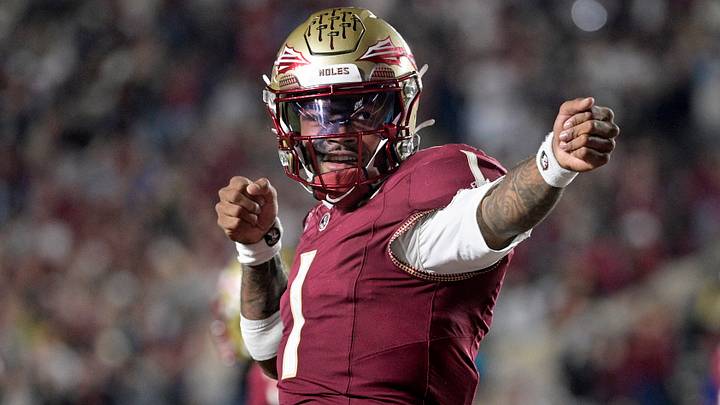
On Tuesday night following Florida State’s first scrimmage of 2026 fall camp, Mike Norvell revealed that his program had “communicated with” some former players about a return for a fifth year of eligibility after an injunction was granted by a federal court making Class of 2022 athletes eligible after the NCAA decided not to grandfather them into the new five-in-five eligibility rule instituted this offseason.
The injunction only applied to Class of 2022 players who exhausted four years of eligibility in four years and who did not sign an NFL contract this offseason. For now, that’s still the case. That narrowed the list of possible former Seminoles returning significantly and put a spotlight on last season’s starting QB Tommy Castellanos, who accepted minicamp invites as a wide receiver but was not signed as an undrafted free agent.
If Castellanos was the player who contacted Florida State, which seems likely but has not been confirmed, it seems the two sides did not reach an agreement because on Thursday, Pete Nakos reported that Castellanos, with the help of college sports’ most high-profile attorney of the NIL era, Darren Heitner, is filing a lawsuit against the NCAA seeking an injunction to enter the transfer portal.
Castellanos is reportedly open to returning as either a quarterback or an athlete, but with Ashton Daniels slated to start in 2026 at QB and young skill-players all over the offense, it seems Florida State has passed.
Tommy Castellanos is suing the NCAA to enter the transfer portal
In anticipation of the five-in-five rule coming into effect, many college basketball players from the 2022 class who exhausted their eligibility this past season entered the transfer portal during the portal window in April. That savvy move, along with the Colorado District Court’s injunction, should allow them to move freely, though the NCAA is appealing the ruling.
Few, if any, college football players had that level of foresight. So, as of now, players can only return to their previous program, which means the ruling will have a fairly insignificant impact on the 2026 season, though Indiana defensive lineman Stephen Daley has since returned to Bloomington.
There just aren’t many like Daley, who are good enough to help a Power 4 team but who didn’t sign an NFL contract of any kind this offseason. Castellanos will argue that if he had known he would be granted a fifth year of eligibility, he would have entered the portal. As messy as it would be, it’s not a bad argument, and with the NCAA’s recent track record in court, it’s probably a winning one.
If he wins, it will allow that very specific type of player to matriculate throughout the sport, in many cases helping less competitive Power 4 programs or even moving down to the Group of Six, because those teams will certainly have use for them.
That movement will already be fairly major, but the real action would come if this line of thinking is followed to its inevitable conclusion. Some player from the 2022 class who signed an NFL contract this offseason, but who isn’t likely to make the 53-man roster for this season, will argue they would not have made the jump to the league had they known they were due a fifth year of eligibility. It seems like a leap in logic, but really it’s the same argument. If Castellanos wins, it’s hard to imagine that case losing.
If those players are ruled eligible, then it’ll be a frenzy. And it won’t be contained to football either. Right now, Castellanos is trying to knock down the first domino.
Of course, this all has to be fast-tracked through the legal system. Week 0 starts on August 28. But even if all of these players are not ready to suit up by then, or if semesters don’t line up for them to enroll right away, there could be very significant midseason additions that could alter the College Football Playoff race.
It sounds far-fetched, but it’s becoming more of a real possibility every day. If Castellanos wins, then it probably becomes a likelihood.
 Add us as a preferred source on Google