

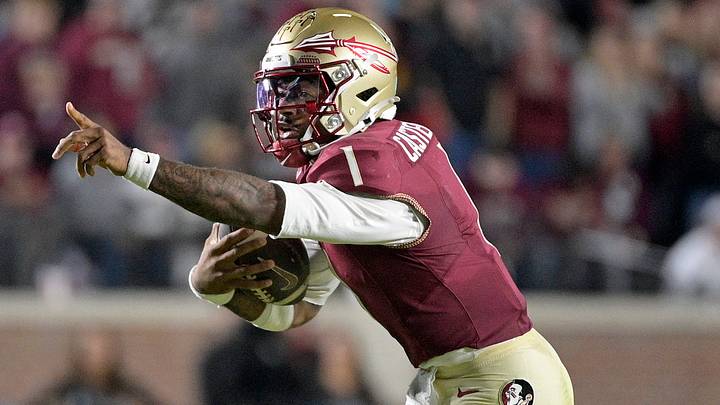
Replacing Tommy Castellanos after he led Florida State to a 5-7 season didn’t necessarily feel like a gargantuan task for Mike Norvell and first-year general manager John Garrett this offseason. The Castellanos-led passing game ranked a modest No. 34 in the country by predicted points added and No. 60 in success rate (per fourthandshort.com), a reflection of his down-to-down inconsistencies.
However, on the most important downs, Castellanos was nails, in the company of Fernando Mendoza, Diego Pavia, CJ Carr, Drew Mestemaker, Julian Sayin, and Trinidad Chambliss. Replicating most of his success seems possible for Auburn transfer Ashton Daniels, but Castellanos' playmaking chops were unique in 2025.
Last season, on passing downs, defined as second-and-long, third-and-long, and fourth downs, Florida State ranked No. 5 in passing success rate at 39.1 percent. That may not seem like a massive number, but Vanderbilt led the country at 46.1 percent, and no other team was over 41 percent.
Those plays kept drives alive, kept the FSU offense on track, and probably should have delivered more than five wins. Despite his limitations, there’s a reason FSU’s offense finished No. 26 in points per drive behind Castellanos, and that hidden playmaking value will be difficult for Daniels to replicate this season.
Tommy Castellanos’ passing down success was a huge piece of FSU’s offense
Castellanos wasn’t a perfect quarterback, but he was a playmaker. The FSU passing offense ranking No. 6 in explosiveness captures some of that, but the better encapsulation is the Seminoles’ passing success rate on passing downs.
Severely undersized, Castellanos’ lack of vision over the middle severely limited Florida State’s passing game and relegated wide receiver Duce Robinson and Micahi Danzy to living outside the numbers. From that perspective, the transition to Daniels will be positive.
Castellanos couldn’t operate consistently from the pocket and routinely bailed to make a play with his feet. A one-read-and-go QB, Castellanos ran for 44 first downs last season, the 19th-most among QBs last season (per PFF). And his passing success rate on passing downs doesn’t even account for those plays.
Somehow, a non-traditional dropback quarterback in a play-action and misdirection-based offense managed to be hyper-efficient when the defense knew a throw was likely coming. The run-heavy nature of Malzahn’s system may have played a role, with a -3.9% pass rate over expectation at times forcing defenses to keep extra defenders in the box and to respect play-action on passing downs.
Still, when the defense knew he had to throw, Castellanos found a way to get it done at an elite level. When the other offenses ranking near the top of a stat like that have many of the best passers in college football, you know it's a good representation of quarterback play.
Ashton Daniels will need to offset FSU’s inevitable late-down regression
Daniels can present many of the same threats as a runner in Norvell’s offense that Castellanos did for Malzahn, and with better size at 6-foot-2, 225 pounds. But he’s a career 60 percent passer who, when dropping back without play-action last season, had a troubling 3.06 time to throw and a 15% scramble rate.
For his career, he has nearly as many interceptions as touchdowns, and last season on those non-play-action dropbacks, had four turnover-worthy plays to just one big-time throw, according to PFF. He’s just not your typical dropback QB who is going to dissect a defense on third-and-long. Even with nearly the same receiving corps as Castellanos had, headlined by Robinson and Danzy, it’s hard to imagine that late-down success rate staying anywhere close to 40%.
So, how will FSU match its offensive production from last year? Well, maybe it won’t, but the path is to limit the impact of those plays. Last season, 30.3% of FSU’s offensive snaps came in passing downs, again defined as second-and-long, third-and-long, and fourth down. The national median was 31%.
Notre Dame was the only other team in the top 10 by passing success rate at over 30 percent.
So again, what’s the formula? Well, FSU was the only offense to finish inside the top-10 by passing success rate on passing downs and outside the top 10 in points per drive. There are two reasons for that.
- Passing down rate: Tennessee was the only top 10 offense by points per drive, and though the Vols were No. 20 by passing down success rate, they had the eighth-lowest rate of passing down plays. Translation: They said on schedule. FSU can do that with a power run game and more efficient play from Daniels, accessing the middle of the field for slants and drags that Castellanos missed.
- Red zone conversions: Florida State finished No. 95 nationally in red zone conversion rate and No. 44 in red zone touchdown rate. Castellanos kept drives alive, but he didn’t do enough to finish them.
 Add us as a preferred source on Google