

The first college football Saturday of the 2026 season began with Harvard to TCU transfer Jaden Craig struggling in a 15-10 loss to North Carolina on a rainy day in Dublin. Afterwards, his head coach Sonny Dykes preached optimism, telling reporters, “I've seen Jaden practice and I know what it's looked like. It didn't really look like that today. I'm sure North Carolina had something to do with that.”
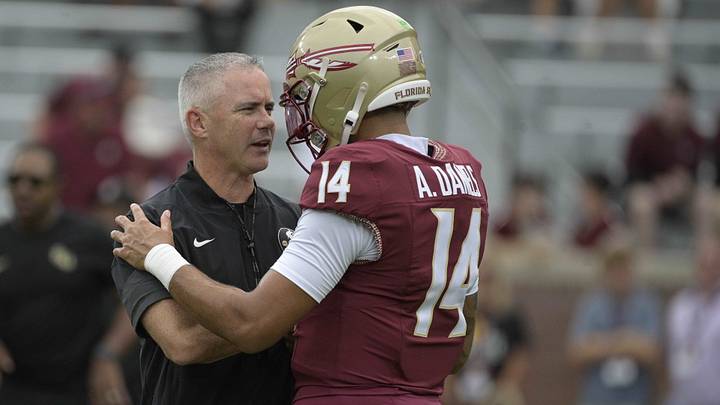
Back stateside this evening, the first primetime slate of the year included Auburn to Florida State transfer Ashton Daniels reaffirming his turnover troubles with an ugly interception as he went 17-27 for 202 yards and a touchdown in a less-than-inspiring debut at Doak Campbell Stadium.
Afterward, Mike Norvell gave the performance a positive spin, telling reporters that “all in all he did what he needed to do, but a lot of areas where he needs to take a step.”
Nowadays, when you have a need to fill at the most important position on the field, you place your bets in the transfer portal and hope you made the right call. While it doesn’t look great after Week 0, Dykes and Norvell are both holding out hope, and there’s plenty of reason for TCU to think the best is yet to come for Craig, but Daniels is who he is, and it’s not going to get better against tougher competition.
Ashton Daniels has played too much football to expect a major breakout
A zero-star recruit in the 2022 class, Craig spent the last four seasons at Harvard, establishing himself as the best quarterback in the Ivy League. At 6-foot-3, 225 pounds, he has a big arm, and while he’s not much of a runner, he’s a solid athlete, as well. The physical tools are so intriguing that he nearly left Harvard for the NFL last offseason, rather than testing the portal waters and finding his way to Fort Worth.
Saturday was ugly, absolutely. But it was his first game against Power 4 competition, where the windows are tighter, the game moves much faster, and the margins are much slimmer. He didn’t look ready for it; at least not yet.
Of course, with a player moving up a level, or in Craig’s case multiple levels, from the Ivy League to the Big 12, there are going to be growing pains, and they were on full display for the entire Emerald Isle to see. But as he plays more football against Power Conference competition, his decision-making will improve, his internal clock will speed up, and those physical tools will start to reveal themselves with more consistent play and more big-time throws.
Saturday night was Ashton Daniels' 24th career start as a Power Conference quarterback. In 2025, he made three starts in the SEC, facing Kentucky, Vanderbilt, and Alabama, and proving to be, if nothing else, an upgrade over former five-star Jackson Arnold. Still, in those games, he had five turnover-worthy plays to four big-time throws; he held onto the ball for nearly 3 seconds per dropback, and he completed fewer than 40 percent of his passes under pressure.
On Saturday night against New Mexico State, Daniels' problems were the same as they always have been. He turned the ball over, he was uncomfortable when pressured, and he held onto the ball too long. Even after a preseason of praise for his newfound decisiveness and command of Mike Norvell’s offense, perhaps unsurprisingly, he was the same player he’s been for the previous 23 starts. And that was against a Conference USA opponent that won four games last season.
Rarely do quarterbacks make a significant jump in their final collegiate season after playing a significant amount of football, and oftentimes, if they do, it’s tied to a major stylistic shift in their game. In 2019, Ed Orgeron brought Joe Brady to LSU to open things up with a spread-and-shred passing game that played to Joe Burrow’s strengths. Needless to say, it worked out. That’s an anomaly.
Bo Nix had a similar story when he transferred from Auburn to Oregon, thriving under Kenny Dillingham. As a play-caller, Mike Norvell isn’t Joe Brady, and he isn’t Kenny Dillingham.
In 2021, Kenny Pickett, who already had 36 starts under his belt, suddenly became a different player. His physical maturity simply reached a level where, at 23 years old, he had physical advantages that unlocked his game. That’s what FSU has to be hoping for, and at a time when being a 23-year-old fifth-year is hardly the advantage it was just one year into the COVID-eligibility era.
Mike Norvell needed to take a bigger swing in the transfer portal
Daniels has some appeal as a big, physical athlete who has a solid arm and presents dual-threat ability. Maybe the plan is to lean more into that against better opponents, but Daniels’ seven carries on Saturday night went for 39 yards. He was hardly a weapon on the ground, though he ran in a touchdown. And that rushing ability isn’t a new skill set; it was already baked into his game when FSU plucked him out of the portal.
For the third straight year, Norvell went to a veteran transfer portal QB, and this time he was seemingly pretty cash-strapped as the administration was seemingly keeping funds in reserve should it need to pay a certain head coach’s expensive buyout at some point this fall.
Even so, FSU should have taken a bigger swing at the QB spot. It should have bet on a player like Craig, who carries question marks as they move up a level, but also brings with them major upside that may not have been tapped into.
Maybe that player is JuCo transfer Malachi Marshall, who apparently had a strong fall camp. More performances like that from Daniels and the calls for Marshall to start will grow louder. But there were other options like Colton Joseph, who went from Old Dominion to Wisconsin or Alonza Barnett III, who went from James Madison to UCF, who carry more risk but have the type of ceiling that, if they hit it, could save Norvell’s job.
 Add us as a preferred source on Google