

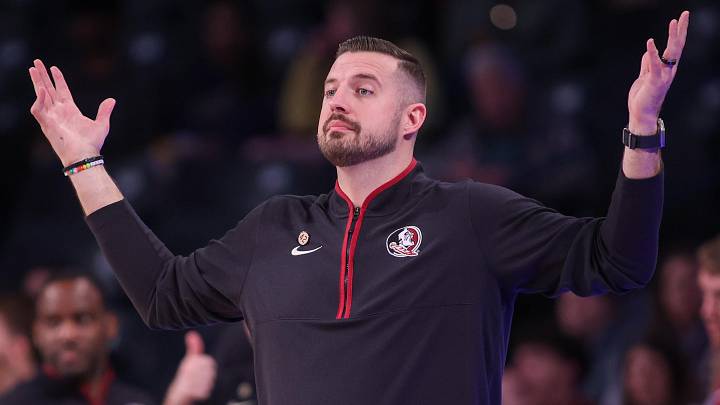
In college basketball, outside of the Michigan States and Purdues of the world, rosters are constantly turning over. So, it’s no surprise that Luke Loucks’ second roster at Florida State won’t look much like his first, which managed an 18-15 record and missed the NCAA Tournament despite an impressive close to the season.
Thanks to new NCAA legislation, which passed on Tuesday and is expected to become final on Wednesday when the Division I Cabinet meeting concludes, Loucks’ Year 3 roster in 2027-28 could look a lot more similar, particularly with transfer guard Anthony Robinson II. The new legislation states that Division I athletes will have up to five years of eligibility if they enroll in college no later than the academic year after their 19th birthday. A longtime proposal, it has become known as the five-in-five rule, giving players five years to complete five seasons of eligibility.
For Robinson and many other players across the country heading into 2026-27 as a fourth-year senior, this means an additional year of eligibility. For Florida State, that could provide some unexpected stability in the backcourt, which could be a gift for Loucks’ rebuild.
An extra year of Anthony Robinson II in the FSU backcourt could be huge
After losing leading scorer Robert McCray V and his backcourt mate Lajae Jones from last year’s roster, Loucks dove into the portal to rebuild that backcourt, plucking out Robinson from Missouri and 6-foot-7 shooting guard Kam Taylor from UNC Asheville. While Taylor is expected to shoulder the scoring load, Robinson, a Tallahassee native, can provide playmaking and point-of-attack defense, everything you’d want from a veteran guard.
There was a significant learning curve for Loucks, still the youngest head coach in college basketball, last season. Having veteran guards like McCray and Jones helped to offset that and helped ease the midseason play-style shift the Seminoles had to undergo. There will undoubtedly be more learning to go for Loucks, so having a veteran guard like Robinson, who played 96 games in his three years at Missouri, will be critical; having him for two years could prove invaluable.
It’s not like the old days in college basketball, where a new head coach had to wait four years to have a veteran presence on his roster. Now, you can import experience, as Dusty May did in Michigan, to win the national championship in Year 2. Loucks has done that, not just adding Robinson, but putting Taylor, Sebastian Rancik, and Shon Abaev around incoming four-star freshman Marcis Ponder.
It’s hard to bank on the core staying around Tallahassee beyond one year because that’s just not how the sport works in the Transfer Portal era. Maybe Robinson even leaves to spend his fifth year of eligibility elsewhere, especially if Loucks didn’t plan for the five-in-five rule and work out a multi-year deal with Robinson. Still, the possibility of stability in Tallahassee is enticing.
 Add us as a preferred source on Google