

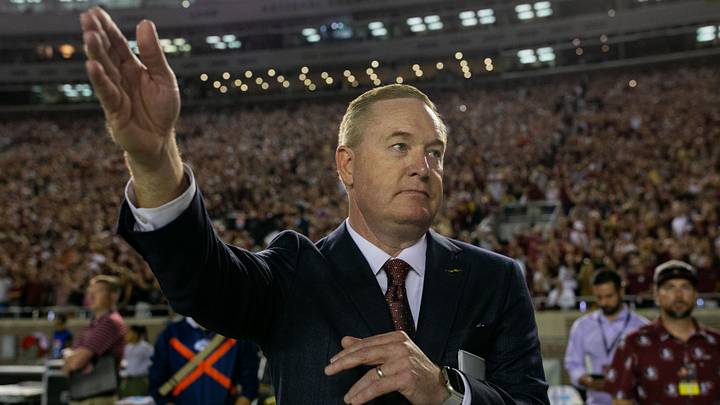
About the time Michael Alford rose from CEO of Florida State’s fundraising arm, Seminole Boosters, to become the school’s athletic director in 2022, Florida State was looking for a way out of the ACC. In August 2023, FSU Trustee Drew Weatherford said, "It's not a matter of if we leave, but how & when we leave.”
Shortly after that statement, and after a 13-0 ACC Championship-winning season, Alford took his two biggest swings during his tenure as AD, which ended on Monday: He handed Mike Norvell an eight-year extension that the program now desperately wants to get out of, and he spearheaded an effort to sue the ACC for its “draconian” exit fees that prevented the Seminoles and Clemson, which was also part of the lawsuit, from taking part in the nationwide realignment that positioned the Big Ten and SEC firmly as college football’s super conferences.
Now, almost three years later, it’s hard to say that Florida State’s ACC exit plan has momentum, with the football program producing losing seasons in 2024 and 2025 and seemingly on the verge of firing Norvell. But for now, that’s a good thing, and whoever is hired to replace Alford and interim athletic director Bruce Warwick should be fine with the status quo because right now, FSU needs the ACC more than ever.
The ACC is the perfect place for Florida State football to get back on its feet
Technically, there is still a Power 4 in college sports, but in reality, there’s a Power 2, and everyone wants to be in it. The ACC is a step down from the Big Ten and the SEC in a lot of ways, but most impactfully, in overall revenue. The ACC’s TV rights deal just isn’t on the same level, which is why, eventually, Florida State should want to get out, but at the moment, the difference in potential TV revenue is offset by how much easier it will be to get back into College Football Playoff contention in the ACC than it would be in the SEC or Big Ten.
Miami is the top dog in the ACC right now, even if it hasn’t yet won a conference title. And thanks to the FSU and Clemson lawsuit, the Hurricanes further cemented their place. That lawsuit altered how the ACC distributes revenue, doing so in a more favorable way for its most successful programs. That has already helped Florida State, but it was massive for Miami because the ACC is the only conference to give all of its College Football Playoff payout to the team that earned it.
Now, that’s not to say that with a new athletic director and a new head coach, once Florida State inevitably fires Norvell, the Seminoles will be in the CFP, let alone winning CFP games. But there’s a much clearer path to that in the ACC than there would be anywhere else.
Sure, the SEC and Big Ten get more teams into the College Football Playoff, but both leagues have multiple programs spending around $40 million on their rosters. The ACC has one. Florida State can start to close that gap on Miami much quicker than any other program in the ACC, and though spending and winning don’t have a direct cause-and-effect relationship, they’re certainly correlated.
Florida State likely isn’t long for the ACC; whether that’s through realignment or a super league in football, it’s hard to imagine the Seminoles not making another attempt to jump ship. But you don’t want to jump when you’re injured. You want to jump from a position of strength, and the ACC can be a springboard for FSU’s new AD and head coach, assuming the administration gets those hires right.
 Add us as a preferred source on Google