

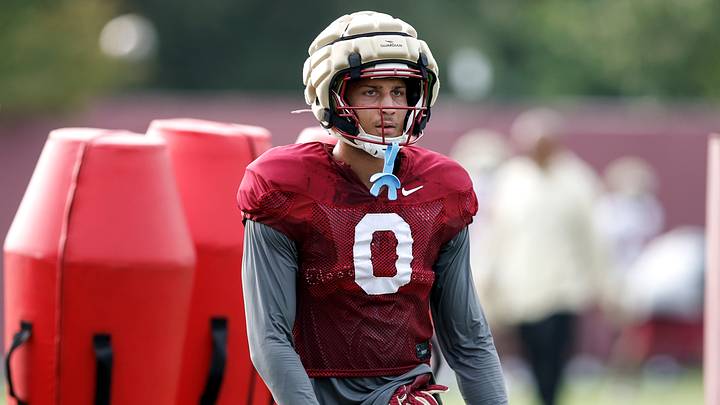
Last season, his first in Tallahassee, Duce Robinson was named to the All-ACC first team after hauling in 56 catches for 1,081 yards for the Seminoles. This year, the expectations are even higher for the 6-foot-6, 230-pound senior, and meeting them rests on more than just his shoulders.
Those high expectations also carry some recognition, as on Tuesday, Robinson was named a second-team preseason All-American by the AP. One of three second-team wide receivers with Indiana’s Charlie Becker and Rutgers’ KJ Duff. Robinson was the lone Seminole on either All-American team.
Now, as Week 0 approaches, the task is to live up to them. He’s talented enough to do it, so if he does is almost entirely reliant on the circumstances around him, particularly his new play-caller and new quarterback.
It’s up to Ashton Daniels and Mike Norvell to get the most out of their star WR
After handing the play-calling duties off to Gus Malzahn last season, head coach Mike Norvell will be back on the headset this year, and with another new quarterback, Ashton Daniels, FSU’s third different opening game starter in as many years. The former Stanford starter transferred in from Auburn after backing up former five-star Jackson Arnold last season and taking over late in the year.
Daniels is a physical runner at 6-foot-2, 225 pounds, and with a bevy of talented running backs behind sophomore Ousmane Kromah, Norvell has been hinting at a 21-personnel (2 running backs, 1 tight end) approach harkening back to his Memphis days when he had multiple future NFL running backs on the roster and produced two 1,000-yard rushers in the same year.
Heavy personnel usage, whether with two running backs or with two tight ends on the field, won’t take Robinson off the field. He’s the team’s bona fide WR1 and a solid blocker. Even with an improved group of pass-catchers around him as Micahi Danzy develops into a more well-rounded route-runner and true freshman Jasen Lopez pushes for playing time. But a run-first approach may keep the ball out of his hands.
That won’t, however, be all that dissimilar from last season when FSU had a -3.9 percent pass rate over expected and an overall 56.7 percent run rate with Malzahn and Tommy Castellanos last year. That number should hold. Game script may force FSU to throw more, but the overall offensive philosophy will likely act as a bit of a restrictor plate on Robinson’s volume.
So, the important questions really are: can Norvell scheme him open, and can Daniels take advantage when he does?
Ashton Daniels can access new areas of the field and offset big-play regression
Tommy Castellanos was a net positive at quarterback, but his size put significant limitations on the system. Simply put, he couldn’t throw over the middle of the field, and that relegated Robinson to running almost exclusively go-balls and comebacks outside the numbers. His average depth of target was 17.0 yards downfield, top 10 in the country among high-volume receivers with at least 50 targets. His 34 contested catch opportunities were second most to Duff.
That volume of contested catch situations is partially a reflection of Robinson’s relative inability to separate from coverage. He’s a big-bodied receiver; that’s going to be his game. Still, Daniels will allow him to run more routes over the middle. Even if there are limitations to his physicality as a route-runner and his separation that probably won’t go away, simply having the threat of snapping off a route to the inside will radically change his approach, and, if he’s on the same page with his new quarterback, his production.
Even for a player like Robinson, who could be the best above-the-rim receiver in the country, 50/50 balls down the sideline are a tough way to live. It’s unlikely he can average 20+ yards per reception again, so his volume needs to tick up to offset that inevitable regression and put together another 1,000-yard season. And he, likely, needs another 1,000-yard season to finish as an All-American, though Carnell Tate was a second-team All-American just last season with 838 yards in 10 games.
It all sounds simple. Though there’s a limit to the number of passes Norvell will want his team to throw in neutral game scripts, he can funnel a higher percentage of them to Robinson with the more well-rounded route-tree Daniels affords.
It may work out that way, but the margins are thin for a wide receiver on a team that, if everything goes well, will run the ball almost 60 percent of the time and try to protect a quarterback who has historically been turnover-prone. Daniels has to earn that trust from Norvell, and Norvell has to build a passing game to maximize Robinson. Even then, defenses may just load up to take WR1 away.
So, will Robinson finish as an All-American? I wouldn’t count on it, but of course, that’s the much easier prediction to make. Only six receivers will be at year’s end; Robinson has the talent to be one of them, but needs more variables to break his way than most.
 Add us as a preferred source on Google