

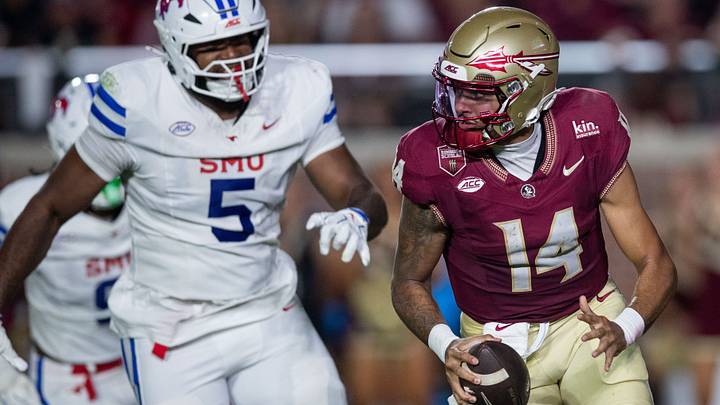
As is always the case with a new starting quarterback, there was plenty of buzz around Ashton Daniels at Florida State this offseason. Reports said that he was playing faster, protecting the ball better, and was finally going to become an additive starting quarterback. Through two games, that hasn’t been the case.
Daniels has put the ball in harm’s way as much as ever; though he has just one interception, he has added little to the run game, and most glaringly, he isn’t playing fast at all. The fifth-year senior’s average time to throw through the Seminoles’ 1-1 start is 3.57 seconds, by far a career high, and that won’t cut it against Alabama, especially if defensive coordinator Kane Wommack continues to embrace pressure as much as he did in the Crimson Tide’s Week 2 win over Kentucky.
In 2025, Wommack, Kalen DeBoer’s then-second-year DC, blitzed on 29.9% of opponents’ dropbacks, the 82nd-highest rate in the FBS. Through two weeks, he’s brought five or more after the quarterback on 53.7% of dropbacks, a severe uptick that reflects his trust in one of the most talented secondaries in the country and that could spell disaster for Daniels.
Ashton Daniels doesn’t play fast enough to punish Alabama’s pressure packages
Simply put, Ashton Daniels doesn’t process fast enough. He didn’t for his two years as a starter at Stanford; he didn’t when he took over for Jackson Arnold at Auburn last year, and he doesn’t now. He needs to see his receiver come up to pull the trigger, and against good defenses, that just isn’t going to happen.
Daniels throws with very little anticipation, and all the offseason talk about him cutting down on turnovers, which have plagued him throughout his entire collegiate career, seems to have him more gun-shy than ever. Even for the best scrambles and out-of-structure creators, 3.57 seconds is an unsustainably high average time to throw.
Last season, the highest time to throw in the country was Mississippi State’s Kamario Taylor at 3.47 seconds, and he’s a much superior athlete to Daniels. Thomas Castellanos was No. 11, but even he was at 3.17 seconds, and his pressure-to-sack rate was a very low 12%. Daniels’ is upwards of 16%, and as a scrambler, he has just 42 rushing yards this year.
Kane Wommack is going to speed Daniels up, and that could be disastrous
Alabama’s secondary is loaded. So, even against a Florida State wide receiver room that is one of the biggest strengths of the roster, he won’t be scared to leave his corners one-on-one. The risk of that decision just doesn’t outweigh the potential reward.
Part of the reason the risk is mitigated is the way Mike Norvell calls his offense this year. He’s overly reliant on an uninspiring tight end room and leans heavily on 21-personnel because of the relative strength of his backfield. In this case, all that will serve to do is bring more Alabama defenders close to the line of scrimmage, allowing Wommack to disguise his pressure looks and torment an offensive line that has already been forced to shuffle its right side.
Kentucky head coach and play-caller Will Stein attempted a similar heavy-personnel game plan on Saturday with much better tight ends and managed a 32% success rate and 3.22 yards per play.
Norvell should attempt to spread and shred this Alabama defense, but to do that, you need a decisive quarterback who sees it quickly and gets the ball out fast. That couldn’t be further from the reality of Daniels.
If Norvell tries to make Daniels play that way, the risk of turnovers ratchets up, and if he doesn’t, Daniels will repeatedly be snowed under by the Crimson Tide pass rush. It’s a lose-lose proposition for the Seminoles, which is often the case for an offense that doesn’t have good quarterback play.
 Add us as a preferred source on Google